
About
The Villa Kathrine
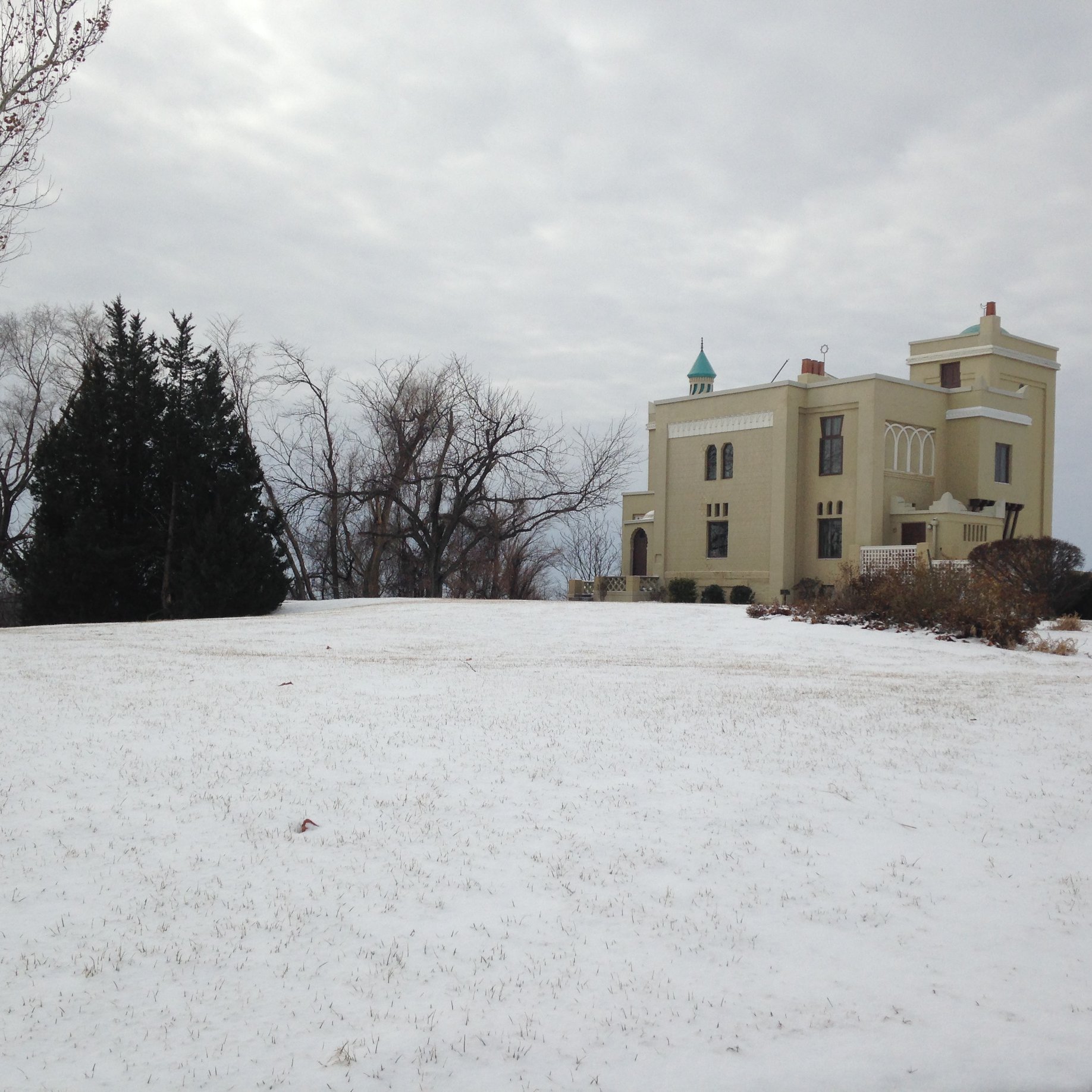
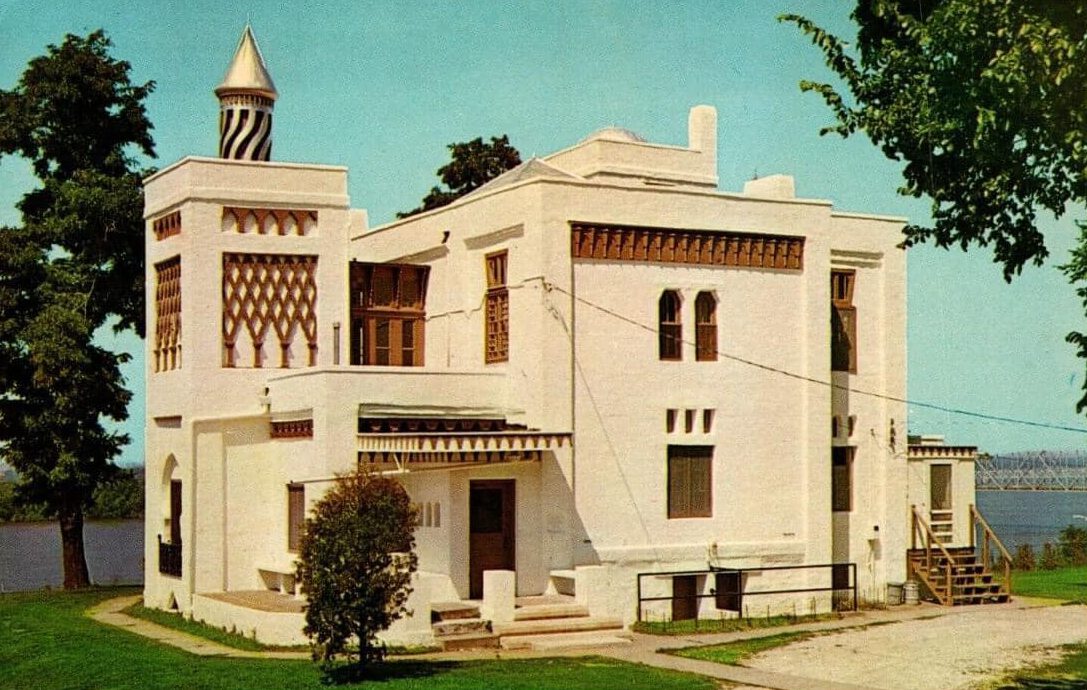
Herman Schachtsiek was the primary builder on the Villa Kathrine. The villa is 2600 square feet, two stories with an open courtyard that once sported a retractable roof. The walls are made of brick covered with stucco. Local materials were used throughout including pine and cypress wood. Iron work was forged in local foundries and the amber glass diamonds were very expensive in 1900.
FPO A Window Into the Past FPO
FPO About Villa Kathrine FPO
The Villa Kathrine, perched high on a bluff overlooking the Mississippi River since 1900, is the only example of Moroccan architecture on the river. Built by Quincy native William George Metz the Villa Kathrine often has her name spelled incorrectly. She was placed on the National Registry of Historic Places in 1979 under the name of Villa de Kathrine. Listed on the Illinois Register of Historic Places and deemed a Quincy Local Landmark. The Villa Kathrine has captured attention not only because of her eclectic architecture, but also because of the spirit and or spirits found to inhabit the building.
Metz Family History
William George Metz (called George), the builder of the Villa Kathrine, was born in Quincy on May 20, 1848. Some documents have his birth year as 1849. Many passports list his birth year as 1948. He was the son of William Metz and Anna Katherine Kientzle who both came from Germany and met in Iowa. They married August 29, 1845 in Farmersvillle, Van Buren County Iowa. They had their first child, Louise in Farmersville in 1847.
William Metz did not feel Iowa was a place to make money so they moved to Quincy where George was born. The Metz family had a total of eight children. Charles Frederick was born November 14, 1852 and died May 3, 1853, Birthdates and death dates are unknown at this time for Anna Matilda, Emma Marie, Hannah Melinda, Henry Edward. Emil E. died on September 23, 1882, at age 20.
George traveled extensively throughout his life. His father died in 1873 and his mother and sister died in 1897, leaving George as the sole heir to the family fortune. His sister Louise did have two daughters, one of whom died at age 22 in 1903. In 1897 George left Quincy for three years traveling through the Mediterranean area and came back with drawings and furnishings to build his Moroccan villa.
There is much more to tell about this interesting Quincy native and a visit to the Villa Kathrine will unlock more of the mysteries.
Architect History
When George Metz returned to Quincy in 1899 he sought to find an architect that would help make his dream home a reality. George P. Behrensmeyer was a young architect that took on the challenge. Working from the drawings furnished by Mr. Metz he came up with a plan for the Villa Kathrine. Seeking out the perfect place to set this unusual home, a spot on the bluff overlooking the Mississippi river was chosen. Bids were let for the plan and the home cost $7000 to build which translates to about $270,00 today.
Facing the wrecking ball several times in her 125 years the Villa Kathrine is rich in legend, lore, truth, and reality. George Metz, hailed as both eccentric and a visionary, built his dream home and christened it Villa Kathrine. Speculation was he named it after his mother or perhaps a woman he met on his travels, whoever it was named for, George never confirmed. When asked, he just chuckled. The one thing for sure is that he shared his home with the biggest dog in America at the time, a huge Mastiff that was brought over from Denmark and Bingo was his name-o. To learn more about this intriguing man and his faithful companion come visit the castle on the bluff and experience the architectural beauty of the Grand Dame of the Gem City known as Quincy, Illinois.
Villa Kathrine Timeline
William George Metz tours North Africa and Spain for two years, gathering materials and inspiration for the building of a Moorish “villa” of his own, using the Villa Ben Ahben in Morocco as starting point.
Metz returns to Quincy, collects his notes, and sketches, and confers with several architects about creating a composite design.
An ideal spot for Metz’s villa is located on a high bluff south of State Street overlooking the Mississippi. Young Quincy architect George Behrensmeyer draws up the plans, reducing the Moroccan villa to 43′ by 53′ and specifying walls of brick with a plaster veneer. Construction of the Villa Kathrine begins, with Herman Schachtsiek as the prime contractor.
The Villa Kathrine is completed, its main tower decorated with latticework inspired by the Giralda in Seville, Spain, and topped with a minaret replicating in miniature that on the Mosque of Thais in Tunisia. A sky-lit interior court is surrounded by columns whose arrangement recalls the Court of Dolls in the Alcazar in Seville and whose twisted forms and capitals are inspired by the famed Alhambra in Granada.
The “Moorish dream palace” is described and illustrated in the March issue of Scientific American Builders Monthly.
Metz sells the Villa Kathrine to Quincy grocer Archibald Behrens, who turns out to be acting for the Alton-Quincy Interurban Railroad. The railroad proposes to build a line to Alton, using the Metz property for a railroad yard. Behrens and his wife, an accomplished artist, are promised the contents of the house as his sales commission but end up with only a rug. Local entrepreneur John J. Fisher, a principal backer of the rail, becomes virtual owner of the property and is believed by Metz to have furnished his house with the Islamic collection.
The interurban rail project fails and ownership of the former Metz property enters 18 years of litigation. Meanwhile the house becomes derelict and is rented out at low rates.
Behrens gives up all claim to the property for $1, and the house begins more than a decade of abandonment.
Under the ownership of Fisher’s company Excelsior Stove Works, the house undergoes its first restoration. Central heating is installed, the reflecting pool is filled with concrete, and the grounds are planted with Lombardy poplars.
The Chicago Daily News publishes a feature article about the still empty ”Moroccan villa” on the Mississippi.
Musician and nightclub owner Bob Moore rents the house with his wife Christine and two children, who are students at Quincy College.
Harold C. McCoy purchases the house, repairs the casement windows and dome, modernizes the electricity, and landscapes the grounds with flowering shrubs and catalpas.
Porter Settle, Jr., buys the house for development into a supper club but soon abandons the project.
Quincy Park District purchases the Villa Kathrine and several lots to the north with a $25,000 donation from the Moorman Company, demolishes the remaining housing, and turns the enlarged property into a neighborhood park and community center under the supervision of the Franklin neighborhood committee.
The grounds of the Villa Kathrine are further enlarged through purchase of a residential lot on Third Street.
The Park District partially restores and upgrades the Villa and various citizens groups.engage in two years of debate concerning the feasibility of restoration and reuse.
The Park District estimates the costs of complete restoration at $150,000, the figure rising to $200,000 the following year.
The Quincy Jaycettes, led by Sharron Jett, spearhead a clean-up effort and incorporate “Friends of the Castle” as a support group for the Villa Kathrine restoration and reuse. The Villa Kathrine is nominated to the National Register of Historic Places; and designated on September 26th.
Quincy Park District leases the Villa Kathrine to Friends of the Castle, and architect Carl Fisher and Associates of Springfield develops a phased restoration proposal.
The City of Quincy, the Federal Highway Administration, Illinois Department of Transportation and Quincy Park District jointly develop a program for the Villa Kathrine as a tourist center. Friends of the Castle member, Robert Christie, is to oversee restoration.
The Great River Road Commission provides a $225,000 grant for Phase I of the work at the Villa Kathrine. A match of $75,000 is raised locally by Friends of the Castle.
Waterkotte Construction completes Phase I, including restoration of the exterior and front parlor, construction of public rest rooms, and a driveway and parking lot.
Bergman Nurseries replants the grounds, using many shrubs of near Eastern origin. Tourist Information Center opens in the parlor of the Villa on. Labor Day, Monday, September 7.
The Illinois Department of Transportation grants $300,000 for Phase Il for finishing exterior restoration, reworking mechanical and electrical systems, and returning the interior to its original plan and appearance. A second local match of $75,000 is required and subsequently raised by Friends of the Castle. Friends of the Castle hires Poepping, Stone, Bach and Associates as architects and engineers for the restoration. Robert Christie is retained as consultant.
llinois Department of Transportation increases Phase II grant to $551,000 with a required increase of the local match to $138,000 raised by Friends of the Castle.
Fischer Builders Inc. completes Phase Il, including restoration of the interior, installation of basement restrooms and an exterior lift for handicap accessibility. The Villa Kathrine is essentially fully restored and maintained by Friends of the Castle.
A capital campaign “Raise the Roof” is accomplished by the Friends of the Castle raising nearly $80,000 to restore the roof and various other maintenance projects around the Villa Kathrine. The Villa Kathrine relies on membership, tours, grants, and donations to fund the maintenance and operation of the Villa Kathrine. An endowment fund has been set up through the Community Foundation of West Central Illinois and Northeast Missouri to ensure the future of the Villa Kathrine.
The Villa Kathrine is granted Quincy Landmark Status by the Quincy Preservation Commission.
The Villa Kathrine is closed for several months during the Covid 19 pandemic. During the closure the outside stucco is restored and coated with a sealer to help stop water wicking through the walls. At the same time Mary Oatman and Susan Scholz redecorated the inside of the Villa Kathrine bringing more authentic furnishings to replicate the decor found in Moroccan villas.
On August 9, 2025, lightning during a storm hit the crescent moon on the roof of the Villa Kathrine starting a fire in the area near the roof entrance. The fire was put out quickly and a small amount of damage from the fire was incurred. However, the lightening went through the building destroying much of the office equipment, appliances, air conditioning and the elevator.
Work is being completed to restore the damage.
Friends of the Castle continues to support the Villa Kathrine. It serves as the official Quincy Tourist Information Center and as a Great River Road Interpretive Center and is the home of the Quincy Convention and Visitors Bureau. The Villa Kathrine operates strictly with volunteers serving on the board and as volunteer hosts.
It is also open for tours, and the grounds are available to rent for weddings, parties, receptions, and other special events. Thanks to the efforts of Friends of the Castle, the Quincy Park District, volunteers and donors, the Villa Kathrine stands as a wonderful and unique architectural example that can be seen from miles away.